It's the water heater (or the corner it sits in)
Where can a water softener drain in a finished basement?
Answered by the column’s editors · · about 5 minutes to read
A water softener drain line has to empty into a trapped receptor, such as a floor drain, laundry standpipe or utility sink, through an air gap. It should never be piped straight into a drain line.
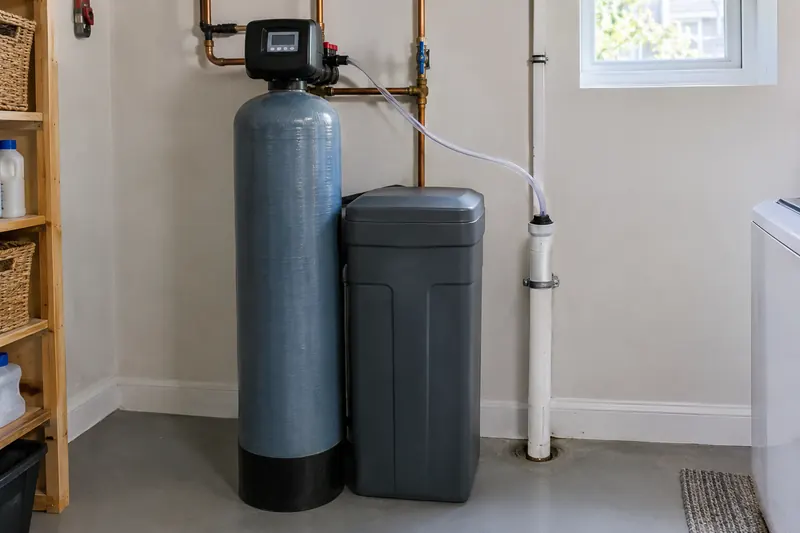
Every softener flushes itself on a schedule. During regeneration it backwashes, rinses with brine and sends that water down a small drain tube, often in the middle of the night. In an unfinished basement nobody thinks twice about where it goes. Once the walls are up and the floor drain is behind a closet, it becomes a real puzzle.
The rule that sorts it out is simple: the tube has to drop its water into something that's already part of the drain system, with open air between the tube and the water below.
Why can't the tube just connect to a drain pipe?
Because a direct connection is a path for dirty water to get back into the softener and, through it, into your drinking water. The model plumbing code treats equipment that discharges clear, nonpotable water as indirect waste: it must drain through an air break or an air gap, not a sealed connection.
An air gap is an open vertical space between the end of the tube and the flood rim of whatever catches the water. The code sets it at no less than twice the effective opening of the waste pipe. The receptor itself has to be trapped, vented and connected to the building drain, so you're feeding an approved fixture, not a random pipe.
What do softener makers ask for?
The makers' manuals line up with the code and add specifics. Pentair's Fleck control valve manual says an air gap of twice the drain line diameter, with a 1-inch minimum, is required. It calls for a residential drain line of at least 1/2 inch, stepping up to 3/4 inch when backwash flow tops 7 gallons per minute or the line runs longer than 20 feet.
The same manual wants the softener in a dry spot that won't freeze, with water pressure no higher than 125 psi. Your model may differ, so the installation section of your own manual is the final word.
Which receptors work in a finished basement?
| Receptor | Works well when | Watch out for |
|---|---|---|
| Floor drain | It's close and stays reachable | A finished floor that hides it; a dry trap that lets odors in |
| Laundry standpipe | The softener sits near the washer | Washer and softener draining at the same moment |
| Laundry or utility sink | There's a sink in the utility room | Clamp the tube so it can't slip below the rim |
| Dedicated standpipe or hub drain | A plumber adds one during the finish work | Needs a trap and vent like any fixture; may need a permit |
A floor drain that only sees softener water now and then can still dry out between regenerations. If yours smells, suspect the trap first; our sewer-smell floor drain answer explains. And if the floor drain already struggles when the washer empties, read why it overflows on wash day before adding softener water to it.
What if the nearest drain is across the room?
Then you have three honest options: move the softener closer to an existing receptor, run a longer line sized to the maker's spec, or have a licensed plumber add a trapped, vented standpipe where you need it. Hiding a tube inside a finished wall with no access isn't a good plan, since you'll want to see that air gap.
Don't improvise by dropping the tube into the sump pit or running it out a window. A sump pit is there for groundwater, and its pump sends water outdoors; ask your permit office before you send brine anywhere other than an approved receptor. Some homes also run a condensate pump for the furnace, which is a separate system covered in where condensate and dehumidifiers should drain.
Do we really need a softener here?
That depends on your water. WSSC Water's 2024 tap analysis averaged 140 mg/L hardness from the Potomac plant against just 64 mg/L for Patuxent-supplied homes, so one source is more than twice as hard as the other. The U.S. Geological Survey calls anything from 121 to 180 mg/L hard, which puts Potomac water in that band and Patuxent water in the "moderately hard" range.
Chart drawn from: WSSC Water tap analysis (archived copy)
Softening also affects the water heater. A.O. Smith cautions that a softener may shorten tank life by eating the anode sooner, which makes the heater manual's anode schedule worth following; our answer on how long water heaters last has more.
The bottom line
A softener can drain to a floor drain, laundry standpipe or utility sink, as long as the tube ends with an open air gap above a trapped, vented receptor. Size the line to the maker's manual, keep the air gap where you can see it, and have a licensed plumber add a proper standpipe if the finished layout leaves no good option.
Readers also ask
How big does the air gap need to be?
The model code says at least twice the effective opening of the drain pipe. Fleck's manual says twice the drain line diameter, never under 1 inch.
Can the softener drain into the washing machine standpipe?
Yes, if the tube is secured with an air gap above the standpipe and the standpipe can handle both flows. Running both at once can cause an overflow.
Can a softener drain line run uphill?
Only if your model's manual allows it, so read the installation section before raising the line.
Does a softener drain need a permit?
It depends on the work. Adding a new standpipe or trap is plumbing work, so ask WSSC Water or your county before the walls close up.
Why does the floor drain smell after the softener runs?
More often the trap had dried out before regeneration. Pour water in it regularly, and see a plumber if the smell keeps coming back.