Something's backing up or smells
Our basement floor drain smells like sewer. What's wrong with it?
Answered by the column’s editors · · about 5 minutes to read
A floor drain that smells like sewer usually has a dry trap: the small pool of water that blocks sewer gas has evaporated. Pour in a bucket of water. If the smell returns quickly, something else is going on.
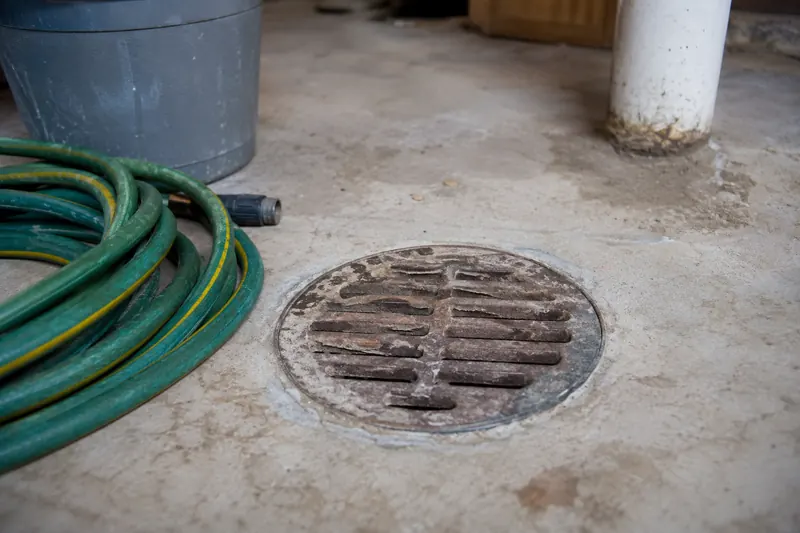
Probably nothing is broken. Every floor drain has a trap below the grate, a U-shaped dip that holds water. That water is the only thing standing between your basement and the sewer air in the pipes beyond it.
Unless the washer or a dehumidifier empties into it, a basement floor drain may not see water for months, and in a dry, heated basement the seal slowly evaporates. Once it's gone, the sewer smell comes straight up through the grate.
Why does a floor drain smell like sewer?
The trap seal is shallow on purpose. The model plumbing code sets a trap's water seal at 2 to 4 inches deep and wants a trap seal primer wherever evaporation can empty it (International Code Council, 2012 IPC). A few inches of water doesn't take long to disappear from a drain nobody uses.
North Dakota's Department of Environmental Quality names the two usual culprits behind sewer odor in a house, leaky plumbing and a dried-out trap on a drain nobody uses, and its fix for the second is simply water poured down the drain (North Dakota DEQ). That's the first thing to try.
How do we refill a dry floor drain trap?
The bucket test
- Lift the grate and look down: if you can't see standing water a few inches below, the trap is probably dry.
- Pour a gallon or two of water slowly down the drain.
- Air the basement out and check the smell the next day.
- Mark the date and check again in a couple of weeks.
- If the smell is back within days, or never left, move on to the table below.
If the smell disappears and slowly comes back over weeks, evaporation is your answer. Pouring a bucket in on a schedule works, but the lasting fix is a trap primer, a device that tops up the trap automatically. The 2012 residential code (IRC), used for houses in some places, says floor drain traps need either a primer or a deep-seal design (International Code Council, 2012 IRC). WSSC regulates houses under the IPC instead and points to the IPC's trap-seal protection rule (WSSC Water code, archived copy). Adding a primer means tapping a water line, so it's a plumber's job.
What if the smell comes back after we refill it?
Then the trap isn't the whole story.
| What you notice | Likely cause | Next step |
|---|---|---|
| Smell returns within hours, drains gurgle | Poor venting pulling water out of the trap | A plumber checks the vent; see the gurgling answer |
| Smell strongest at the sump or ejector lid | Lid not sealed | A sewage basin needs a sealed, gas-tight cover |
| Smell from inside the drain body, trap holds water | Missing or loose cleanout plug in the drain | Replace the plug |
| Dirty water or sludge in the drain | Partial backup or buildup | Clean it out; watch for backups |
| Smell around a basement toilet or shower too | Shared venting or seal problem | See the basement bathroom answer |
Venting matters because the code limits the air-pressure swing on any trap seal to 1 inch of water column. When the vents can't keep up, flushing or draining elsewhere sucks the seal out of the trap, which is why gurgling and smells often travel together. Our page on why basement drains gurgle covers that. If the smell is around a bathroom, read why a clean basement bathroom still smells.
Pits are another suspect. According to Liberty Pumps, a sewage basin's cover has to be sealed to keep the gas in (Liberty Pumps FAQ), and the model code also calls for a gas-tight cover on a sump pit. Not sure which kind of pit you have? Start with ejector pump vs. sump pump.
Is a sewer smell in the basement dangerous?
A faint whiff from a dry trap is mostly unpleasant. If dirty water is coming up the drain too, see our answer on sewage at the floor drain.
When cleaning a smelly drain, never combine bleach with ammonia or other cleaners.
Who fixes it, and does it need a permit?
Refilling a trap is a homeowner job; replacing a trap, adding a primer or fixing a vent is plumbing work. In Montgomery and Prince George's that usually means a WSSC-licensed plumber, though WSSC allows some homeowner permits after an open-book exam; elsewhere your county sets the rules. Our page on who issues plumbing permits sorts out which office is yours.
The bottom line
Start with a bucket of water. If the smell goes away and slowly returns, the trap is drying out and a trap primer is the lasting fix. If it comes back fast, or comes with gurgling or dirty water, call a plumber to check the vent, the cleanout plug and the pit lids.
Readers also ask
How often should we pour water into a floor drain?
Often enough that it never dries out; tie it to a chore you already do. If it dries in weeks, ask about a primer.
Can we just cover the floor drain?
Don't seal it permanently; it takes water off the floor in a leak.
Does a sewer smell mean the main line is clogged?
Not by itself; a clog shows up as slow drains or backups.
Why does the smell get worse in winter?
Heated, dry indoor air speeds up evaporation, so traps dry faster when the furnace runs.
Should the sump pit lid be sealed?
The model code calls for a gas-tight, removable cover on a sump pit, and sewage basins must be sealed.
Where this answer comes from
- ICC 2012 International Plumbing Code (Public.Resource.Org)
- ICC 2012 International Residential Code (Public.Resource.Org)
- ICC 2012 IRC, plain-text copy at the Internet Archive
- North Dakota DEQ: where indoor sewer gas comes from
- WSSC Water: trap seal protection in its current code (archived copy)
- Liberty Pumps FAQ, page 4: sealed sewage basin covers
- Washington Gas: if you smell gas
- CDC: never mix bleach with other cleaners