It's the water heater (or the corner it sits in)
The water heater is leaking from the bottom. Is it done?
Answered by the column’s editors · · about 5 minutes to read
A water heater leaking from the bottom is often, but not always, finished. If the tank itself is seeping, plan on a replacement. If it's coming from the drain valve or the relief valve pipe, a repair may do.
A puddle at the base can come from three or four places. Some are cheap fixes; one is the end of the tank's life.
So find where the water starts. Dry the floor, wipe the heater's base and watch with a flashlight. Where the first drop forms tells you most of what you need to know.
Where is the water actually coming from?
Work from the top down; water pools at the base wherever it started.
| Source | What you'll see | Usual outcome |
|---|---|---|
| Relief valve discharge pipe | Drips from the open end of the pipe that runs down the side | Find out why the valve is opening |
| Drain valve near the bottom | Wet spot under the spigot-like valve, or a drip from its tip | Repair or replace the valve |
| Fittings on top | Water tracking down the jacket from above | Tighten or replace fittings |
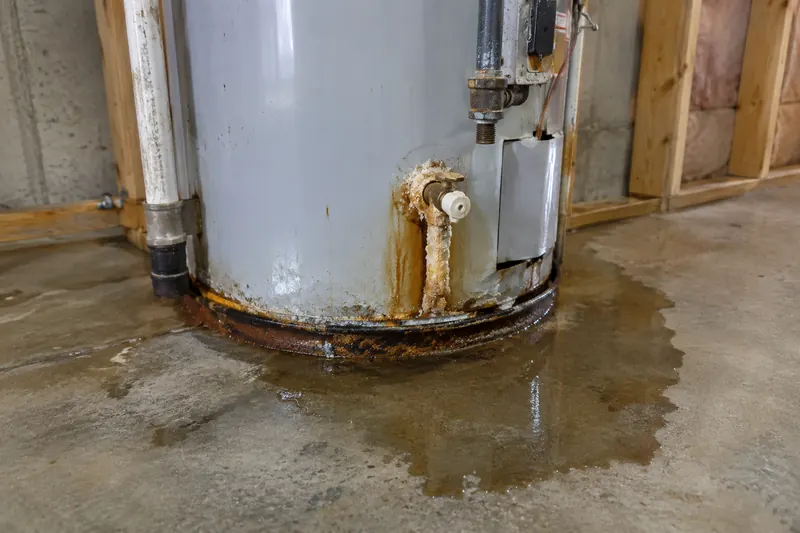
| The tank itself | Seepage from under the jacket, rust, mineral crust | Replace the heater |
What does it mean if the tank is leaking?
That's the bad news case. The steel tank inside the insulated jacket is protected by a lining and by an anode rod that slowly wears away instead of the tank. A.O. Smith explains that once the anode is used up, the tank will start to corrode, eventually developing a leak. There's no fix for a rusted-through tank.
Age is a strong hint. The U.S. Department of Energy gives traditional tank heaters 10 to 15 years of service. If yours is in that range and water is seeping from under the jacket, start planning the replacement. Our answer on how old is too old for a water heater covers how to read the date on the label.
Why would the relief valve pipe drip?
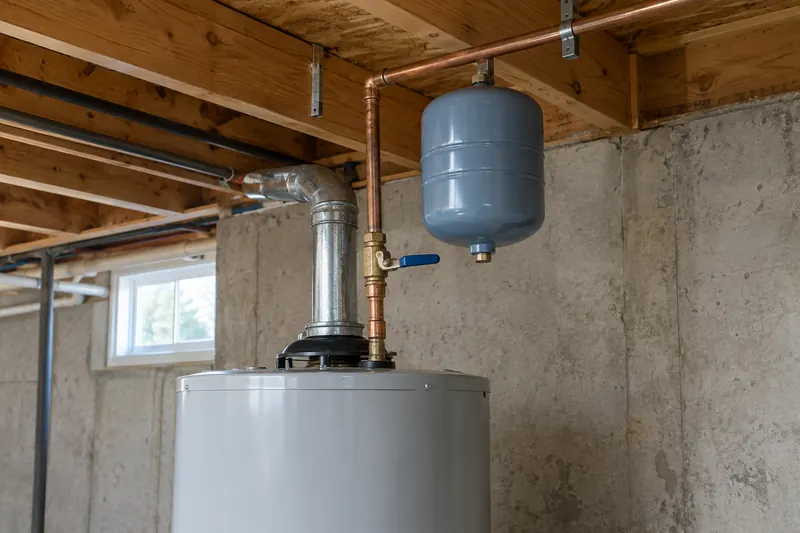
The T&P (temperature and pressure) valve opens when pressure or temperature inside the tank gets too high. A drip from its pipe is a symptom, not the disease. One frequent cause is thermal expansion in a closed system: A.O. Smith warns that expansion can make the relief valve drip and can shorten tank life, and that the valve isn't built to handle that job over and over. That's the reason plumbers fit an expansion tank.
Amtrol's manual says a licensed contractor should inspect the relief valve whenever it has discharged, and on a regular schedule even if it hasn't. So a dripping relief pipe is a call to a plumber, not something to plug.
What should we do right now?
While you wait for the plumber
- Keep children and pets away from the heater and the hot water.
- For an electric heater, switch off its breaker at the panel, as long as you aren't standing in water to reach it.
- For a gas heater, leave the gas controls alone; the plumber will deal with them.
- Close the cold-water valve on the pipe feeding the heater if the leak is more than a drip.
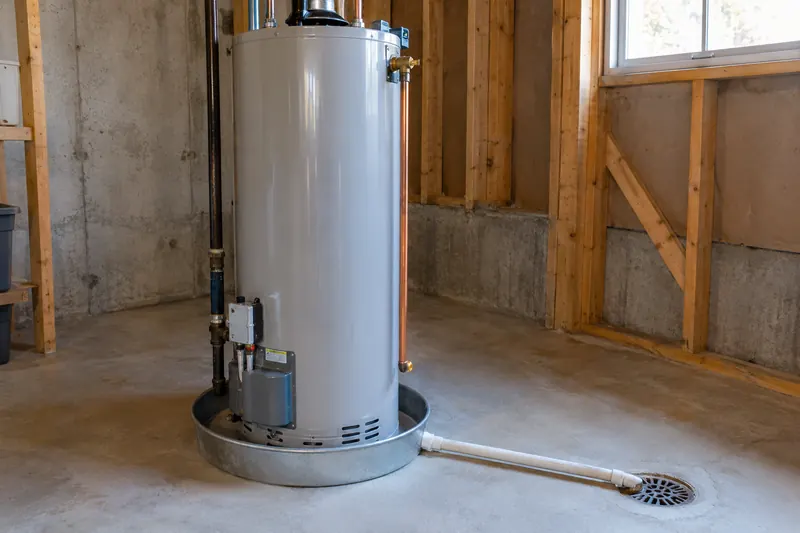
- Move boxes and rugs out of the way and dry the floor, or let the drain pan carry it off.
- Take a photo of the label and the leak for the plumber and your insurer.
Anything past a breaker and a shutoff valve belongs to a pro. Electric heater repairs mean live wiring inside the jacket, and gas controls need a licensed gasfitter.
Can the drain valve or a fitting be fixed?
Usually, yes. A drain valve that weeps after someone flushed the tank, or a loose connection on top, is a part replacement, not a new heater. On an older tank, a licensed plumber can say whether the money is better spent on a new heater.
Who is allowed to replace the heater?
It depends on fuel and county. In Montgomery and Prince George's, WSSC Water's code lets electric heaters be replaced without a permit when no concealed piping changes, but gas water heater replacement takes a WSSC-licensed plumber, a permit and a WSSC inspection. In Frederick County, a like-kind water heater in an owner-occupied home can go in without a permit, but a licensed plumber still has to do it. Baltimore County requires a permit for all plumbing and gasfitting work. If you're replacing anyway, it's a good moment to add a drain pan under the new heater.
The bottom line
Find where the water starts before you decide. A dripping relief pipe or drain valve usually means a repair and a closer look at pressure; seepage from the tank itself means the heater is done. Keep everything past a breaker or water shutoff with a licensed plumber.
Readers also ask
Is it safe to keep using a leaking water heater?
For a small drip from a valve, often for a short time, with a plumber on the way. For seepage from the tank, plan on replacing it soon, since corrosion only gets worse.
Can you patch a leaking water heater tank?
No. Once the steel tank has corroded through, the fix is a new heater.
Why is there water under the heater but nothing is dripping?
Check the pipe fittings on top and the relief pipe after the heater runs. Water can run down the jacket and pool at the base without an obvious drip.
Does homeowners insurance pay for a leaking water heater?
Policies differ, and the heater itself is usually treated as wear and tear. Check your policy before cleanup starts, and photograph the damage first.
Will a water softener make the tank leak sooner?
It can wear the anode faster. A.O. Smith says softened water may shorten tank life, so softened homes should follow the maker's anode advice in the heater manual.
Where this answer comes from
- A.O. Smith: heater instructions on anodes, expansion and leaks
- U.S. Department of Energy: Tankless Water Heaters, Building America 2009
- AMTROL: expansion tank and relief valve guidance
- WSSC Water: Gas Appliance FAQs (archived copy)
- Frederick County: replacement notice (archived copy)
- Baltimore County: Plumbing and Gasfitting Permit (archived copy)
- CPSC: Avoiding Tap Water Scalds
- U.S. EPA: mold and moisture guide