Our outside faucet froze and now it leaks inside the wall. What happened?
Answered by the column’s editors · · about 5 minutes to read
An outdoor faucet frozen with a hose still attached usually splits the long tube that runs back through the wall. The crack stays hidden until you next open the faucet, then water pours into the wall or basement.
You're far from the first household to discover this in spring. The faucet worked fine all fall, the hose stayed connected through a cold snap, and the first time someone turned it on to water the garden, the basement ceiling started dripping.
The good news: it's a single part, it's a common repair, and the fix for next winter is simple. The bad news is that the water already in the wall needs drying out quickly.
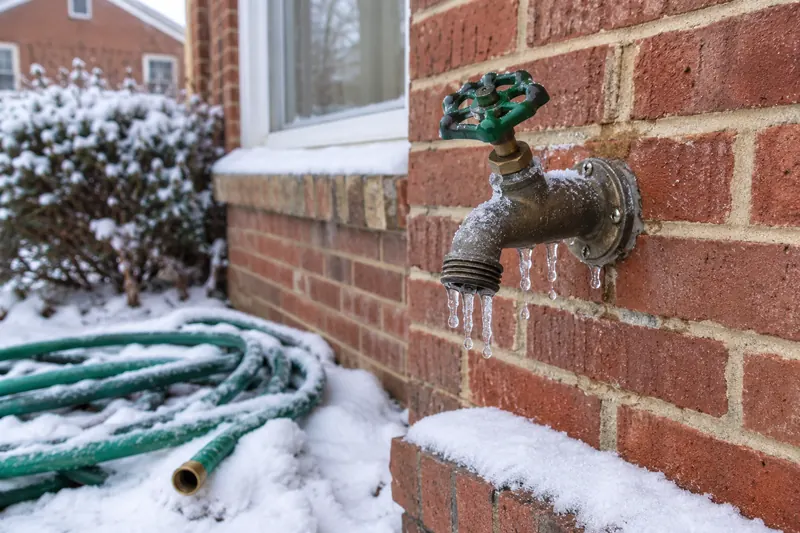
How does a frost-free faucet freeze if it's frost-free?
A frost-free faucet, also called a freezeless wall hydrant or sillcock, puts the actual shutoff valve at the inside end of a long tube, back where the house is warm. When you close the handle, the water left in the tube is supposed to run out the spout. Prier's installation sheet says every freezeless hydrant needs a slight downward pitch for that draining to work, and that the valve must sit in a heated part of the house.
Now attach a hose. The hose holds water in the tube, so the tube can't drain. On a hard night that trapped water freezes, expands and splits the tube somewhere inside the wall. Prier's sheet puts its warning in capital letters: remove the hose whenever temperatures drop below freezing.
Why didn't it leak until we turned it on?
Because the split is downstream of the valve. With the handle closed, there's no water pressure in the cracked section, so nothing leaks all winter. Open the handle and water rushes down the tube, hits the split, and sprays into the wall cavity or the basement ceiling instead of out the spout.
That's why the leak often shows up weeks or months after the freeze that caused it. If your faucet gives a weak stream outside while you hear water running indoors, you've found the problem.
What about an older faucet with a shutoff inside?
Older homes often have a plain outdoor faucet fed by a separate valve inside the basement. These aren't frost-free at all; the pipe between the inside valve and the wall stays full of water unless someone drains it. WSSC Water's winter checklist (archived copy) says to close that inside valve, disconnect the hose and drain the line. The American Red Cross (archived copy) adds a useful detail: leave the outside faucet open afterward so any water left inside can expand without breaking the pipe.
| Faucet type | Where the valve sits | How it usually fails | Winter routine |
|---|---|---|---|
| Frost-free sillcock | Inside the heated house, at the end of a long tube | Hose left on, tube splits in the wall | Remove the hose before freezing weather |
| Standard faucet with inside shutoff | A separate valve in the basement | Line not drained, pipe splits near the wall | Close inside valve, drain, leave outside faucet open |
| Frost-free faucet with poor pitch | Inside, but tube slopes back toward the house | Water pools in the tube and freezes | Have a plumber correct the slope |
What should we do right now?
Stop the water first, then deal with the wet wall.
First steps after the leak
- Close the faucet, then close the inside valve that feeds it, or the main shutoff if there isn't one.
- Don't use the outdoor faucet again until it's repaired.
- Open the basement ceiling or wall enough to see the wet area and let air in.
- Dry everything that got wet, using fans and a dehumidifier.
- Call a licensed plumber to replace the faucet, and confirm the license first.
Speed matters with the drying. The EPA's mold guide gives a 24-to-48-hour drying window for wet materials, so open things up the same day. For what to cut out versus what can be saved, see how fast mold starts after a leak.
Who fixes it, and can we prevent a repeat?
A split frost-free faucet is normally replaced, not patched, because the crack is inside the tube. In WSSC's two counties, the utility requires its own licensed plumbers for most jobs; elsewhere your county's licensing rules apply. Our guide to checking a plumber's license shows where to look.
When the new faucet goes in, ask the plumber to confirm the downward pitch and that the valve end sits inside heated space. Then build the fall habit: hose off, every time, before the first freeze. If you're traveling, our checklist for a winter trip covers outdoor faucets along with the rest of the house.
Small leaks add up even outdoors. The EPA's WaterSense program notes that a faucet dripping once per second wastes more than 3,000 gallons a year, and suggests checking in-ground irrigation each spring for frost damage.
The bottom line
A hose left on a frost-free faucet traps water that freezes and splits the tube inside your wall, and the leak only shows when you next open the faucet. Shut the water off, get the wall dry fast, and let a licensed plumber replace the faucet. Then take the hose off every fall.
Readers also ask
Can a frozen outdoor faucet be thawed and reused?
If it froze but didn't split, yes; warm it gently and check for leaks indoors when you open it. Our safe thawing page lists the methods.
Does an insulated cover over the faucet help?
It slows heat loss at the spout, but it won't save a faucet with a hose attached, because the hose keeps water in the tube.
Why does water drip from the spout for a moment after we shut it off?
That's normal on a frost-free faucet. The tube is draining, which is exactly what protects it. Prier's sheet notes the hydrant drains for a few moments after you close it.
Is the leak covered by homeowners insurance?
That depends on your policy and how the damage happened. Call your insurer, and take photos before you start drying things out.